AI Agents vs AI Chatbots: What’s the Difference for Businesses?”
Learn the differences between AI agents and AI chatbots, their business use cases, and how Odoo ERP Consulting helps integrate intelligent automation for greater efficiency.
AI Agents vs AI Chatbots: What’s the Difference for Businesses?
Artificial intelligence is rapidly changing how businesses interact with customers, automate operations, and improve decision-making. From answering customer questions to managing complex workflows, AI-powered solutions are becoming an essential part of digital transformation strategies.
Among the most talked-about technologies are AI chatbots and AI agents. Although the terms are often used interchangeably, they represent two distinct approaches to automation. Choosing the wrong solution can result in limited functionality, unnecessary implementation costs, and missed opportunities to improve productivity.
For businesses already investing in enterprise platforms, this distinction becomes even more important. Organizations exploring Odoo ERP Consulting services frequently ask whether AI should simply respond to customer queries or actively execute business processes inside their ERP system. The answer depends on the complexity of the workflows, the level of autonomy required, and the desired business outcomes.
This article explains the differences between AI agents and AI chatbots, compares their strengths and limitations, explores real-world business applications, and discusses how intelligent automation can be integrated with Odoo ERP to improve operational efficiency.
Why Businesses Are Investing in AI Automation
Artificial intelligence is no longer reserved for large enterprises with dedicated research teams. Cloud computing, large language models, and API-driven software have made AI accessible to organizations of every size.
Businesses are adopting AI for several reasons:
- Faster customer support
- Reduced operational costs
- Improved employee productivity
- Better decision-making through data analysis
- Automation of repetitive administrative work
According to McKinsey’s 2025 State of AI Report, more than 78% of organizations now use AI in at least one business function, reflecting a significant increase in enterprise adoption over recent years. Rather than replacing employees, businesses are increasingly using AI to eliminate repetitive tasks and allow teams to focus on higher-value work.
For companies running integrated business platforms like Odoo ERP, AI represents an opportunity to automate not just conversations but complete business workflows.
What Is an AI Chatbot?
An AI chatbot is a conversational software application designed to communicate with users through text or voice. Its primary responsibility is to answer questions, provide information, guide users through predefined processes, and assist with customer service interactions.
Modern AI chatbots use natural language processing (NLP) and large language models to understand user intent more effectively than traditional rule-based bots.
Unlike older chatbots that relied entirely on scripted decision trees, today’s AI-powered chatbots can understand context, generate natural responses, and retrieve information from connected systems.
For example, an eCommerce chatbot may:
- Answer shipping questions
- Help customers track orders
- Recommend products
- Explain return policies
- Collect support requests
Although these capabilities significantly improve customer experience, the chatbot usually operates within predefined boundaries. It provides information rather than independently making business decisions.
If a customer asks to modify an order, approve a refund, or update inventory records, the chatbot typically transfers the request to a human employee or invokes another business system to complete the task.
In other words, chatbots are excellent digital assistants but are generally not autonomous decision-makers.
Key Characteristics of AI Chatbots
AI chatbots are designed around conversation. Their primary objective is to understand user questions and provide relevant responses as accurately as possible.
Some of their defining characteristics include:
- Conversational interface
- Customer support automation
- Knowledge-base retrieval
- FAQ handling
- Guided workflows
- Appointment scheduling
- Lead qualification
Many organizations deploy chatbots on websites, mobile applications, WhatsApp, Microsoft Teams, Slack, and social media platforms because they provide immediate assistance while reducing customer support workloads.
However, their effectiveness depends heavily on the quality of the underlying knowledge base and the integrations available with other business systems.
What Is an AI Agent?
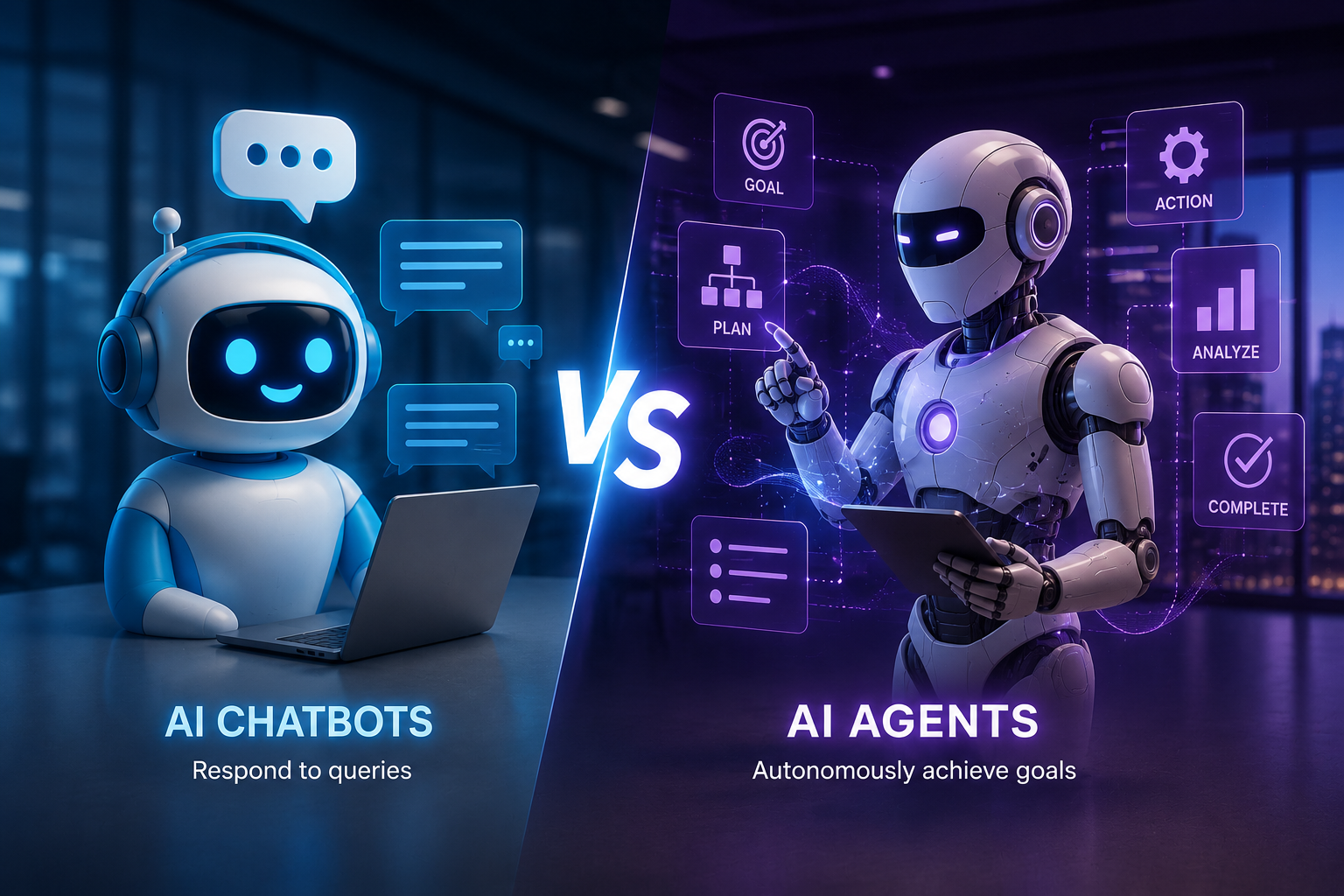
While chatbots primarily focus on conversation, AI agents are designed to accomplish objectives.
An AI agent is an autonomous software system capable of understanding goals, planning multiple steps, interacting with different software applications, making decisions based on available data, and executing actions with minimal human intervention.
Rather than simply answering a question, an AI agent can determine what needs to be done and perform the required tasks.
Imagine a sales manager asking:
“Create a quotation for our largest customer using last month’s pricing, check inventory availability, schedule delivery, and notify the warehouse.\”
A chatbot may explain how to complete these tasks.
An AI agent, however, can perform each step automatically by interacting with connected business applications, APIs, CRM systems, ERP modules, inventory databases, and scheduling platforms.This ability to reason across multiple systems makes AI agents significantly more powerful for operational automation.
How AI Agents Work
AI agents typically combine several technologies to execute complex business processes.
First, they interpret the user’s request using a large language model. Next, they identify which systems or tools they need to access. They then create an execution plan, perform each required action, evaluate the results, and adjust if necessary before completing the task.Instead of following a rigid script, AI agents can adapt their behavior based on changing circumstances.
For example, if inventory is unavailable in one warehouse, the agent may automatically check another location, suggest alternative products, update estimated delivery dates, and notify the customer—all without requiring manual intervention.This level of autonomous reasoning is what differentiates AI agents from traditional conversational assistants.
Why AI Agents Are Becoming Essential for Modern Businesses
Businesses increasingly operate across dozens of software applications, including CRM platforms, ERP systems, accounting software, marketing automation tools, customer support systems, and analytics dashboards. Managing these disconnected systems manually consumes valuable employee time and often leads to inefficiencies.
AI agents address this challenge by acting as intelligent coordinators between systems. Instead of requiring employees to switch between applications, copy information, or trigger workflows manually, an AI agent can retrieve data, execute tasks, and keep business processes moving with minimal human involvement.
This is where Odoo ERP Consulting becomes particularly valuable. A well-planned ERP implementation provides a centralized business platform, while AI agents add an intelligent automation layer that can interact with sales, inventory, purchasing, finance, customer support, and other Odoo modules. Together, they enable organizations to move beyond simple automation toward more adaptive and efficient operations.
AI Agents vs AI Chatbots: A Detailed Comparison
Although AI chatbots and AI agents both rely on artificial intelligence, they solve different business problems. Understanding these differences helps organizations invest in the right technology instead of expecting one solution to perform the role of the other.
A chatbot is primarily designed to communicate. It answers questions, provides information, and guides users through conversations. An AI agent, on the other hand, is designed to achieve outcomes. It doesn’t simply respond—it can analyze situations, make decisions based on predefined rules or business logic, and execute tasks across multiple systems.
For businesses, the distinction matters because customer interaction is only one part of digital transformation. Internal operations such as procurement, inventory management, finance, sales, and HR often require automation that goes far beyond answering questions.Organizations investing in Odoo ERP Consulting increasingly look for AI capabilities that improve operational efficiency across departments rather than only enhancing customer support.
Business Use Cases for AI Agents
AI agents become valuable when organizations want software to perform work rather than simply provide information.
Consider a manufacturing company that receives a large customer order. Instead of asking employees to manually coordinate every department, an AI agent can verify inventory levels, generate procurement requests for missing materials, update production schedules, reserve warehouse capacity, estimate delivery dates, and notify the sales team—all as part of a single automated process.
A finance department can use AI agents to reconcile invoices, identify unusual transactions for review, generate monthly financial summaries, and initiate approval workflows for payments.Sales teams benefit from AI agents that automatically qualify incoming leads, enrich customer records with external data, assign opportunities to the appropriate representatives, and schedule follow-up activities based on buying signals.
Human resources departments can automate employee onboarding by creating user accounts, assigning training modules, preparing documentation, scheduling orientation sessions, and notifying managers when each step is complete.These examples demonstrate that AI agents are not simply improving conversations—they are reducing manual work across the organization.
AI Agents Inside Odoo ERP
Businesses using Odoo often manage multiple core functions within a single platform, including sales, CRM, inventory, purchasing, accounting, manufacturing, and customer support.When combined with intelligent automation through Odoo ERP Consulting, AI agents can enhance these modules in practical ways.
For example, an AI agent connected to Odoo CRM can monitor new leads, evaluate historical purchasing patterns, prioritize opportunities, recommend follow-up actions, and even draft personalized sales emails for review.Within inventory management, the agent can identify products approaching reorder thresholds, analyze seasonal demand trends, generate purchase recommendations, and notify procurement teams before stock shortages occur.
Finance teams can use AI agents to review outstanding invoices, predict potential payment delays, identify anomalies in expense reports, and generate executive dashboards summarizing key performance indicators.Because Odoo centralizes business data, AI agents gain access to richer information, enabling more informed decisions and more effective automation than isolated AI tools.
Advantages and Limitations of AI Chatbots
AI chatbots remain one of the fastest and most cost-effective ways to introduce artificial intelligence into an organization.
They improve customer satisfaction by providing immediate responses at any time of day, reducing waiting times and allowing support staff to focus on more complex inquiries. Businesses with high volumes of repetitive questions often see noticeable efficiency gains after deploying well-designed chatbots.
However, chatbots have limitations. They generally cannot execute complex business workflows independently, and their effectiveness depends on the quality of their knowledge base and integrations. When conversations extend beyond predefined capabilities, human intervention is still required.For many organizations, this is perfectly acceptable because their primary objective is improving communication rather than automating internal operations.
Advantages and Limitations of AI Agents
AI agents offer significantly broader capabilities by automating end-to-end business processes, reducing repetitive work, and enabling faster decision-making across departments. They can improve productivity, minimize manual errors, and help organizations scale operations without increasing administrative overhead.
However, implementing AI agents is more complex than deploying chatbots. They require access to business systems, clearly defined permissions, governance policies, and ongoing monitoring to ensure accurate and secure execution. Successful adoption often depends on careful planning, integration expertise, and change management.
This is one reason many businesses work with experienced Odoo ERP Consulting partners—to design AI workflows that align with existing processes while maintaining security, compliance, and operational control.
Best Practices for Successful AI Adoption
Organizations that achieve the strongest results typically approach AI as an ongoing business capability rather than a one-time software implementation.
Begin with a clearly defined business objective instead of selecting AI tools first. Whether the goal is improving customer service, reducing invoice processing time, increasing sales productivity, or optimizing inventory management, measurable objectives make it easier to evaluate success.Build automation gradually by starting with high-impact, low-risk workflows before expanding to more complex processes. This approach minimizes disruption while giving employees confidence in the technology.
Maintain strong governance throughout the implementation. AI agents should have role-based permissions, transparent decision logs, and human approval for actions involving financial transactions or sensitive customer information.Finally, continuously review performance after deployment. Business processes evolve over time, and AI workflows should be refined using operational data, employee feedback, and changing organizational priorities.
Conclusion
AI chatbots and AI agents represent different stages of business automation rather than competing technologies.Chatbots excel at engaging users, answering questions, and delivering responsive customer experiences. AI agents extend those capabilities by planning, executing, and optimizing business workflows across multiple systems.
As organizations continue adopting artificial intelligence, success will depend less on selecting the most advanced technology and more on choosing solutions that align with specific operational goals. Businesses that understand where conversational AI ends and autonomous automation begins are better positioned to improve efficiency, reduce manual effort, and create scalable digital operations.
For organizations planning enterprise automation initiatives, Odoo ERP Consulting provides a strong foundation by connecting AI capabilities with centralized business processes. When implemented strategically, AI agents and AI chatbots can work together to deliver measurable improvements in productivity, customer experience, and long-term business growth.