This question has become increasingly important in 2026 as companies prioritize scalability, operational efficiency, and digital transformation initiatives. While pre-built SaaS platforms and packaged software can provide fast deployment and lower upfront costs, they often introduce limitations as businesses scale.
Custom software development, on the other hand, allows organizations to build systems aligned directly with their workflows, growth strategy, and long-term operational requirements.
According to a recent Deloitte digital transformation study, more than 70% of organizations say operational flexibility and scalability are now major drivers behind custom technology investments. At the same time, Gartner estimates that businesses lose substantial productivity annually due to disconnected software ecosystems and inefficient manual workarounds created by rigid off-the-shelf platforms.
Understanding the long-term trade-offs between these two approaches is essential for making the right technology investment.
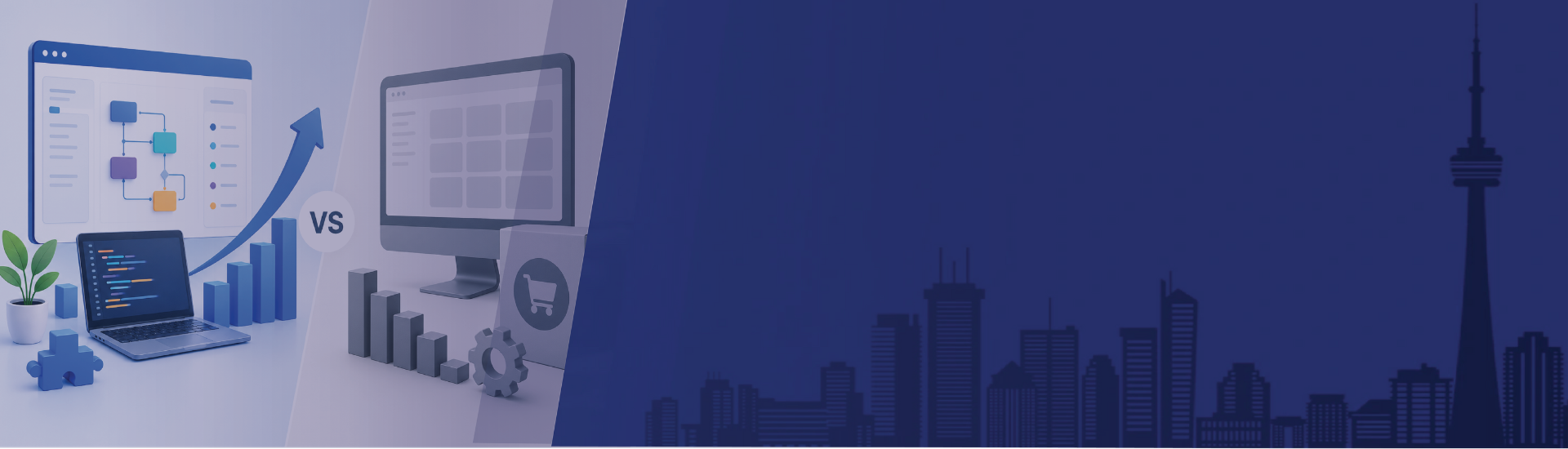
Custom Software Development vs Off-the-Shelf Solutions: Which Scales Better?
Understanding custom software development vs off-the-shelf solutions and which scales better requires evaluating more than initial pricing. Scalability depends on how well software adapts to evolving business needs over time.
Off-the-shelf solutions are designed to serve broad audiences with generalized functionality. They often work well for startups or businesses with relatively standard operational requirements. However, as organizations grow, they frequently encounter limitations involving integrations, workflow customization, reporting flexibility, and operational efficiency.
Custom software development takes a different approach. Instead of adapting business operations around software limitations, businesses create software aligned with their specific workflows, goals, and scalability requirements.
The key difference is flexibility.
Custom software evolves with the organization, while off-the-shelf platforms often force businesses to operate within predefined constraints.
What Are Off-the-Shelf Software Solutions?
Off-the-shelf software refers to pre-built applications designed for mass-market use.
Examples include:
- CRM platforms
- Accounting software
- Project management tools
- Inventory management systems
- HR platforms
- Ecommerce solutions
These products typically operate using subscription-based SaaS models and provide standardized functionality intended to support a broad range of businesses.
The primary advantage of off-the-shelf software is speed. Businesses can deploy these systems quickly without waiting for lengthy development cycles.
For many smaller organizations, this approach works well initially.
However, scalability challenges often emerge over time.
Advantages of Off-the-Shelf Software
#1. Faster Initial Deployment
One of the biggest advantages of off-the-shelf platforms is rapid implementation.
Businesses can often:
- Create accounts immediately
- Configure settings quickly
- Begin operations within days
This makes SaaS platforms attractive for startups or organizations seeking rapid operational setup.
#2. Lower Upfront Costs
Pre-built software typically requires lower initial investment compared to custom software development.
Subscription-based pricing models reduce:
- Initial infrastructure costs
- Development expenses
- Technical staffing requirements
This makes off-the-shelf solutions accessible to businesses with limited budgets.
#3. Vendor Maintenance and Updates
Most SaaS providers manage:
- Security updates
- Infrastructure maintenance
- Feature releases
- Platform monitoring
Businesses using these solutions benefit from ongoing vendor support without managing technical infrastructure internally.
The Scalability Limitations of Off-the-Shelf Software
While off-the-shelf solutions provide convenience, limitations often emerge as operational complexity increases.
#1. Workflow Constraints
Generalized software platforms are designed for broad audiences rather than unique operational models.
As businesses scale, teams frequently create manual workarounds because the software cannot fully support:
- Industry-specific workflows
- Multi-step approvals
- Custom operational logic
- Specialized reporting requirements
These workarounds reduce efficiency and create operational friction.
#2. Integration Challenges
Modern businesses rely on multiple systems operating together seamlessly.
However, many off-the-shelf platforms:
- Provide limited API flexibility
- Restrict deep integrations
- Require expensive third-party middleware
Disconnected systems create data silos and increase manual coordination costs.
According to MuleSoft research, employees spend nearly 20% of their time searching for information across disconnected systems, highlighting the operational impact of fragmented technology ecosystems.
#3. Rising Long-Term Costs
Although SaaS solutions often appear affordable initially, subscription costs can increase substantially as organizations scale.
Additional expenses frequently include:
- Per-user licensing
- Premium feature upgrades
- API usage fees
- Third-party integration tools
- Storage and data overage costs
Over several years, these recurring costs can exceed the investment required for custom software development.
#4. Rising Long-Term Costs
Although SaaS solutions often appear affordable initially, subscription costs can increase substantially as organizations scale.
Additional expenses frequently include:
- Per-user licensing
- Premium feature upgrades
- API usage fees
- Third-party integration tools
- Storage and data overage costs
Over several years, these recurring costs can exceed the investment required for custom software development.
What Is Custom Software Development?
Custom software development involves building technology solutions specifically tailored to a business’s operational requirements, workflows, and growth objectives.
Rather than adapting operations to fit software limitations, businesses create systems aligned with how they actually work.
Custom software may include:
- Internal operational platforms
- Customer portals
- Workflow automation systems
- ERP integrations
- Custom CRM solutions
- Industry-specific applications
This approach provides significantly greater flexibility and scalability.
Advantages of Custom Software Development
#1. Scalability Built Around Your Business
One of the biggest advantages of custom software is that scalability is designed intentionally from the beginning.
As the organization grows, the software can evolve to support:
- Additional users
- New workflows
- Expanded integrations
- Multi-location operations
- Advanced reporting requirements
This flexibility allows businesses to scale without rebuilding operational processes repeatedly.
#2. Improved Operational Efficiency
Custom software eliminates many of the manual workarounds required by generic platforms.
Processes can be optimized specifically for:
- Team collaboration
- Data flow
- Approval logic
- Automation opportunities
This reduces operational overhead and improves productivity across departments.
#3. Better System Integration
Custom software can integrate deeply with existing business systems, including:
- ERP platforms
- CRM systems
- Ecommerce solutions
- Accounting software
- Third-party APIs
This creates centralized operational ecosystems instead of fragmented software silos.
#4. Competitive Advantage
Custom platforms allow businesses to create unique workflows and customer experiences that competitors cannot easily replicate.
This becomes particularly valuable in industries where:
- Operational efficiency matters
- Customer experience differentiation is critical
- Complex workflows require specialized solutions
Custom software enables businesses to innovate operationally rather than conform to generalized processes.
The Long-Term ROI of Custom Software Development
Custom software development often requires greater upfront investment, but the long-term ROI can be substantial.
Benefits typically include:
- Reduced recurring subscription costs
- Lower administrative overhead
- Improved process efficiency
- Better scalability
- Increased operational visibility
- Reduced dependency on third-party vendors
As businesses scale, these operational efficiencies compound significantly.
When Off-the-Shelf Software Makes Sense
Despite its limitations, off-the-shelf software remains valuable in many scenarios.
It is often the right choice when:
- Operational requirements are relatively standard
- Rapid deployment is critical
- Budget constraints are significant
- The organization is still validating business models
- Custom workflows are not yet necessary
Many businesses begin with SaaS platforms before transitioning toward custom development as complexity increases.
When Custom Software Development Makes More Sense
Custom software development is often the better long-term choice when:
- Operations involve complex workflows
- Multiple systems require integration
- Scalability is a strategic priority
- Competitive differentiation matters
- Existing software creates operational bottlenecks
Organizations experiencing rapid growth often reach a point where operational flexibility becomes more valuable than initial software convenience.
Choosing the Right Development Partner
Successful software development depends heavily on strategic planning and technical architecture.
An experienced development partner evaluates:
- Current operational pain points
- Long-term scalability goals
- Integration requirements
- User experience expectations
- Security and compliance considerations
At Continuum Digital, our custom software development services help businesses design scalable technology solutions aligned with operational growth and digital transformation objectives.
Instead of forcing businesses into rigid software ecosystems, custom development creates platforms that evolve alongside the organization.
Final Thoughts
The decision between custom software development and off-the-shelf solutions is ultimately a decision about scalability, flexibility, and operational control.
Off-the-shelf platforms offer speed and convenience, but they often introduce long-term limitations as businesses grow. Custom software development requires greater initial investment, but it provides the flexibility and scalability necessary to support evolving operational needs.
In 2026, organizations focused on sustainable growth increasingly recognize that technology should adapt to the business — not the other way around.
Businesses that invest strategically in scalable software architecture today position themselves for stronger operational efficiency, better customer experiences, and long-term competitive advantage.