Shared Business Context
Stakeholders align on the operating challenge, affected users, constraints, and desired outcome.

Our approach
We connect operational priorities, measurable outcomes, and practical technology decisions—so ERP, automation, software, AI, and digital platforms create lasting business value.
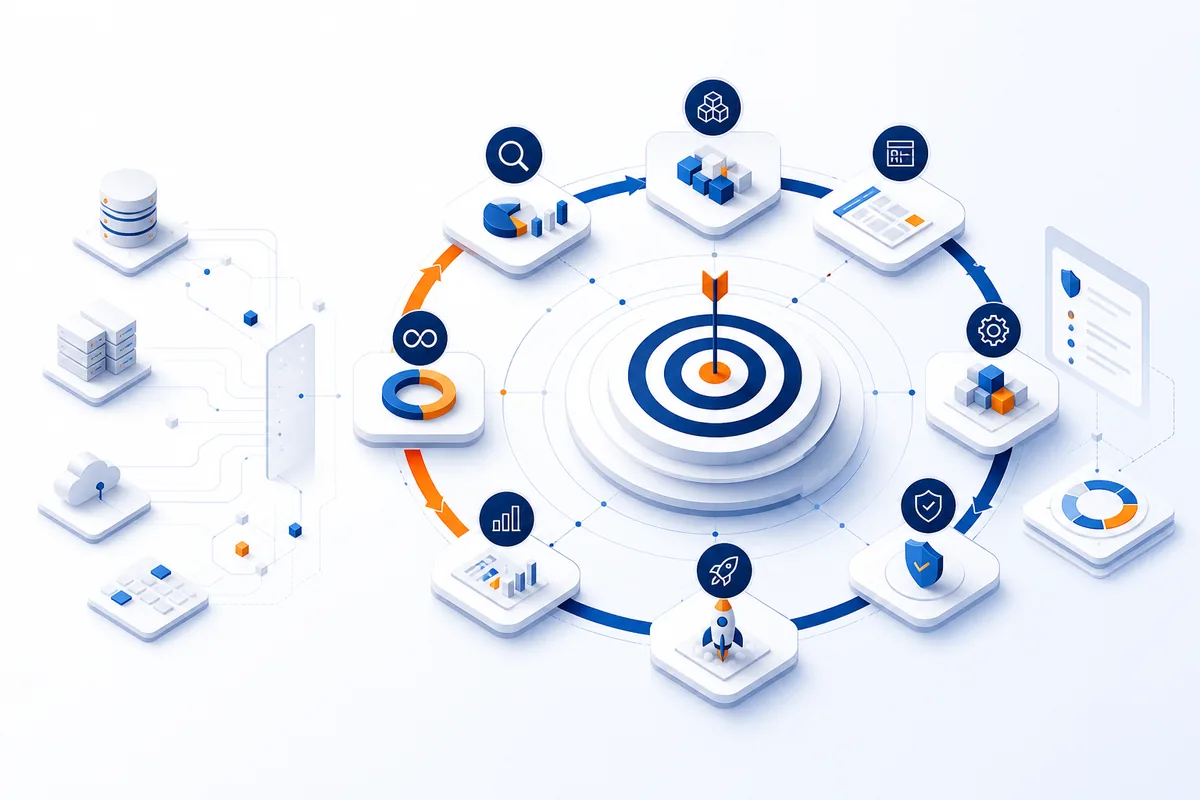
Strategy before technology
Continuum Digital begins every engagement by understanding how the business operates today, where teams encounter friction, and which outcomes matter most. This creates a shared foundation for digital transformation planning before a platform, framework, or implementation path is selected.
We translate operational challenges into clear requirements, priorities, success measures, and delivery decisions. The result is a practical roadmap that connects business stakeholders with product, design, engineering, data, and change-enablement needs.
Whether the engagement involves Odoo ERP, custom software, AI and automation, or connected digital platforms, the goal remains the same: deliver measurable improvement without creating unnecessary complexity.
Why our approach works
A disciplined consulting approach keeps business priorities visible from discovery through long-term optimization.
Stakeholders align on the operating challenge, affected users, constraints, and desired outcome.
Requirements are organized around business value, risk, dependencies, and measurable success.
Delivery is structured into practical increments with regular review and transparent decisions.
Architecture, adoption, support, and improvement are considered before launch—not after it.
From context to continuous value
Each stage produces a useful business decision or delivery outcome. Activities scale to the engagement rather than forcing every project into the same playbook.
Discover
Review objectives, workflows, users, systems, data, constraints, and existing pain points. Establish the business problem and the evidence needed to measure change.
Outcome: shared context and prioritized opportunities.Define
Clarify requirements, scope, stakeholders, dependencies, risks, and success measures. Separate immediate priorities from later opportunities.
Outcome: agreed requirements, scope, and decision criteria.Design & Architecture
Define solution architecture, data flow, integration boundaries, security needs, product experience, and appropriate technologies. Prototype key workflows where early validation reduces risk.
Outcome: a practical blueprint aligned with business and technical needs.Build in Phases
Configure, develop, integrate, and review the solution through focused phases. Demonstrations and stakeholder feedback keep implementation connected to actual workflows.
Outcome: visible progress with controlled scope and decision points.Validate
Validate functional behavior, integrations, performance, security, accessibility, reporting, and user acceptance according to the solution's risk profile.
Outcome: evidence that the solution is ready for real operations.Launch & Enable
Coordinate deployment, migration, documentation, training, communication, and handover where applicable. Launch planning accounts for operational continuity.
Outcome: an orderly transition with users and support teams prepared.Support & Optimize
Monitor adoption, reliability, feedback, and outcome measures. Prioritize refinements, automation opportunities, integrations, and future phases based on evidence.
Outcome: continuous improvement and a sustainable technology foundation.Governance throughout
Governance is not a final approval meeting. It is the continuous practice of making priorities, responsibilities, risks, evidence, and changes visible to the people who depend on the outcome.
How we work
Technology decisions are evaluated against operational goals, user needs, measurable outcomes, risk, and total ownership—not technical novelty alone.
Work is organized into clear decisions and phases. Stakeholders can see what is being delivered, why it matters, and which dependencies or trade-offs require attention.
Early discovery, architecture review, prototypes where useful, incremental delivery, and proportionate testing surface issues before they become expensive commitments.
Support and optimization focus on adoption, performance, reliability, feedback, and the next opportunities to improve business outcomes.
Technology selected with purpose
The right technology mix depends on the business context. These capability families represent platforms and tools Continuum may use where they fit the solution.
Odoo ERP · Microsoft Dynamics 365 · Salesforce · HubSpot CRM · process automation · system integration
Explore ERP implementation →PHP · Laravel · Node.js · Python · REST APIs · JSON-based integrations · database-backed applications
Explore custom development →JavaScript · TypeScript · React · Flutter · React Native · Swift/iOS · Kotlin/Android · responsive web delivery
Explore digital platforms →OpenAI integrations · Anthropic Claude · AI agents · LLM integration · RAG · workflow automation
Explore AI & automation →WordPress · WooCommerce · Shopify · Magento · Drupal · content and commerce integrations
Explore our services →MySQL · PostgreSQL · SQL Server · Power BI · GA4 · GTM · Microsoft Clarity · Linux · Docker · Git/GitHub · CI/CD
Explore connected operations →Industry context matters
The questions remain disciplined, but the operating realities differ. Continuum adapts discovery, governance, solution design, validation, and enablement to the processes, users, data, and risks of each environment.
Explore Industries →Common questions
We begin by understanding the business objective, current workflows, stakeholders, systems, data, constraints, and measures of success. The depth of discovery is adjusted to the size and risk of the engagement.
The same decision principles apply, but activities are scaled to the project. Smaller initiatives may combine stages, while complex ERP, integration, or platform programs may require deeper discovery, validation, and enablement.
Stakeholders participate in priority decisions, workflow validation, demonstrations, acceptance activities, and launch preparation. Communication and governance are matched to the decisions each group needs to make.
Technologies are evaluated against requirements, existing systems, integration and security needs, team capabilities, usability, scalability, supportability, and total ownership. We do not select tools simply because they are fashionable.
Yes. The approach can support modernization, integration, extension, product delivery, or advisory work around existing systems. Responsibilities and governance are clarified during discovery and solution definition.
Support may include monitoring, issue resolution, maintenance, adoption feedback, performance improvement, integrations, automation opportunities, and planning for later phases according to the engagement.